

















@


NEWS  
NEWS FEATURES  
INTERVIEWS  
POLITICAL COLUMN  
EDITORIAL  
OPINION  
SPORTS  
CARTOON  
BUSINESS  
EYE - FEATURES  
LETTERS  
EVENTS  
SOUL - YOUTH MAG  
ENTERTAINMENT  


Interviews


SLFP at large does not hold MRs views: SB

If you go to a referendum on a federal solution today it would get defeated, because the anti-federal view had been injected into the people so much. But from 1994 to 1999 the Sudu Nelum Vyaparaya went around the country promoting devolution of power while the government was waging a war.

By Kesara Abeywardena
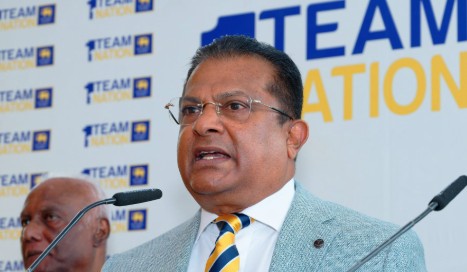
UNP strongman S.B. Dissanayake is spearheading a new movement to promote federalism and devolution of power as a solution to the North-East problem. This new movement is named as the Eksath Janatha Viyaparaya or the United People’s Movement. Dissanayake says that the intention of their movement is to counter the militarist propaganda of the nationalist organisations and the JVP and the JHU while taking the message that devolution of power is the ultimate solution to the national problem in the country. He is also of the view that the majority in the SLFP and the People’s Alliance are for a united Sri Lanka and opt for a federal solution.

Excerpts of the
interview:


Q. What is the objective of the new Eksath Janatha Viyaparaya (United People’s Movement) spearheaded by you?
A
. This is aimed at promoting federalism and benefits of devolution of power, among the people of the country. Earlier during the People’s Alliance government there was a movement called Sudu Nelum Viyaparaya that was led by Mangala Samaraweera. If the people of this country became aware of devolution of power it was through this movement. Afterwards during our UNP government we went further in the peace process. We initiated discussions with the LTTE on extensive devolution of power. But that process got halted midway through after President Chandrika Kumaratunga dissolved parliament. Now everything has taken an about turn. Organisations like the JVP, JHU, the National Movement Against Terrorism are saying that the unitary nature of the state should not be changed. So what is happening in the country now is that an extremist, militant war mentality is being spread around coupled with intolerance. If you consider the extent these extremist views have gone into the minds of the people, even those who prefer genuine devolution of power are scared to even tell the word ‘federal’ in public. The UNP is scared to say it. Sections in the SLFP who are for genuine devolution, the LSSP, the Communist Party are scared to say it. The word federal had been shown as such a bad thing by these people so that most are scared to even utter the word. Our intention is to gather together political parties and organisations that are for a genuine power sharing and take this message among the people again.

Q. What are the organizations and political parties who are in this movement?
A.
There are sections of the SLFP, the UNP, the SLMC, the TNA in this. We are trying to get the CWC and the Upcountry People’s Front also into it. We are also talking with the LSSP and the Communist party.

Q. What is the need for such a movement in the country?
A.
During the time of Chandrika Kumaratunga the People’s Alliance was for genuine devolution of power. That’s how we were able to abandon a unitary state and adopt the stance for a united country. That view was completely overturned by Mahinda Rajapaksa. He got the strength to do that from the JVP and the JHU. But a large section in the SLFP and parties like the LSSP and the Communist party are for devolution of power. That is why such a report came out of the Experts panel of the All Party Representative Committee. What we are trying to do is get all these people together in one platform and take the message that the only answer to the problem in the country is a federal solution.

Q. While the country is in a different mood aren’t you trying to swim upstream?
A.
I don’t think that nationalist movements have won in this country. There is no such huge nationalist wave in this country. It is not us but they who are trying to swim upstream. Chandrika Kumaratunga came to power in 1994 with 62.7 percent vote by saying openly that she will go for genuine devolution of power and address the grievances of the people in the North through a united Sri Lanka. Mahinda Rajapaksa got just 50 percent. Even within that the strength of those who were for a genuine devolution of power remained unchanged. The JVP and the JHU joined as just appendages. The SLFP is a party that has embraced devolution of power. When we brought a resolution before the SLFP for a united Sri Lanka, we approached Mrs. Sirimavo Bandaranaike to get her opinion. She said that she would raise both her hands for it. Even at that time Mahinda Rajapaksa was of a different opinion. Therefore am positive that even today the SLFP at large does not hold the view of Mahinda Rajapaksa. The People’s Alliance is of totally different opinion to that of Mahinda Rajapaksa. Through the Eksath Janatha Viyaparaya we are trying to take that message to the people and tell them that the way to solve this problem is through a federal solution and even at the moment there is no unitary status in the Sri Lankan government after the enactment of the 13th amendment to the constitution.

Q. Why are you promoting federalism so much?
A.
Unitary nature is not a developed form of governance. All countries have shed their unitary character when they have reached higher stages of development and when they have matured democratically. The unitary nature was brought upon this country by the British Empire. Before that during various periods in history there had been several kingdoms. Whenever you find a Buddhist artifact in the North to say there was a Sinhala settlement there is wrong. Because at one point in history, with the Asokan Empire spreading over India, the entire south India was Buddhist. There were Tamil Buddhists all over. Most of the people belonging to the Dravidian family were Buddhists. It was much later they became Hindus. Also, all of us in Sri Lanka are highly mixed. There are no pure racial lines among any of us.

Q. How is your movement going to go forward in the backdrop of the MoU signed between the two parties?
A.
What we are asking is to fully implement the MoU. What we see now is that Mahinda Rajapaksa is doing only what he wants by taking cover of the MoU. Today businessmen are being abducted within the Colombo city. But the government has not taken action to arrest the situation. Is there a solution for this within the MoU. President Mahinda Rajapaksa only wants the war. He does not want to devolve power. He tells one thing to the Tamils and the international community and tells another to the JVP and the JHU.

Q. What kind of action do you plan in taking your message to the people?
A.
We don’t have money like the Desha Hitaishi Vyaparaya, but we hope to hold seminars and rallies all over the country to educate the people.

Q. There is a big controversy over the all party conference reports with two committees submitting two different reports. What is your observation on it?
A.
Who appointed the experts panel in the All Party Conference; it was President Mahinda Rajapaksa. Why did eleven out of the sixteen in the expert’s panel go on one way? That’s because it is the true representation of this government. The majority of this government is for devolution of power although they keep their mouth shut. That diversity in the All Party Conference expert’s panel is the true ratio of the government. The SLFP and the People’s Alliance are not in the stance taken by the President. The majority in that alliance are for a federal solution.

Q. Is the UNP going to back the Majority report or the Committee ‘A’ report?
A.
As the UNP, it is not for us to back this or that report. What we are telling President Mahinda Rajapaksa is to present his proposals before the people and we will discuss it afterwards. Anyway, it is a good basis to begin talks. But first of all Mahinda Rajapaksa should tell that these are his proposals.

Q. Do you think if you go for a referendum on a federal solution at the moment, the people would accept it?
A.
If you go to a referendum on a federal solution today it would get defeated, because the anti-federal view had been injected into the people so much. But from 1994 to 1999 the Sudu Nelum Vyaparaya went around the country promoting devolution of power while the government was waging a war. We went for nine elections at that time and talked about genuine power sharing, and we won all those elections. We must take this message back to the people and am sure that the people will accept it.

****

CBK should not criticise Mahinda

She has again criticised the leader and I do not agree with Kumaratunga’s attitude towards the present head of state.

By Wilson Gnanadass
Seasoned politician and Minister of Power and Energy John Seneviratne, is not satisfied how business in his own party, the Sri Lanka Freedom Party (SLFP) is conducted. He is very concerned about the entry of former President Kumaratunga and the criticism she has leveled against the present leadership. In an interview with The Nation the humble politician said everybody must understand and acknowledge the fact that it is Mahinda Rajapaksa who is the leader of the party and the country. “I certainly do not agree with CBK’s attitude towards the present President,” he said.

Following are excerpts:

Q: What is the progress of the MoU signed between the UNP and the SLFP?
A:
The MoU was signed between these two parties to facilitate a suitable solution to the ethnic crisis. As regards to other matters also, the SLFP and the UNP working together will provide an atmosphere where a significant progress can be achieved in the fields of economic development, good governance and electoral reforms. These are very important for the well being and the future of Sri Lanka. This progress cannot be achieved unless there is a consensus between the two major parties. At the last budget there was a constituent partner of the government, which was threatening to vote against the budget if their proposals were not included. If the government was to depend on this party to win the budget the government would have been largely embarrassed. The UNP from the beginning projected its compliance with the MoU and voted for the budget. And this pushed this particular party also to silently vote for the budget. As regards to the electoral reforms, I think the MoU is providing a comfortable atmosphere to push it through provided both parties are able to convince other parties. There is a necessity for constitutional reforms for a stable government. So that, decisions may be taken at the correct time in order to solve the problems we are facing right now. Because of the MoU, we find that there is a consensus on many issues pertaining to the electoral reforms that is right now being discussed at a parliamentary select committee level headed by Minister Dinesh Gunewardene

Q: While the MoU is signed between two traditional rivals, the JVP walks out of the APRC. Does it mean the whole purpose of this MoU is going to be in vain
A:
There have always been doubts about a possibility of reaching a consensus to the ethnic crisis with a party like the JVP. This is why I personally welcome the unity between the UNP and the SLFP. Now everybody is convinced that it is impossible to solve the ethnic crisis with the participation of the JVP, which has publicly declared that they are against the devolution of powers to the peripheries. They do not seem to be agreeing on a constitutional approach towards finding a solution to the problem. They are more concerned about building up a popular acceptance for their party. I think their decision to boycott the APRC has indicated to the entire nation that they are not sensitive to the burning issues the country is faced with. However, no process can be halted as a result of this. We will go on regardless

Q: Do you now regret that President Mahinda Rajapaksa signed the MoU with the JVP
A:
At a time the President signed the MoU, he would not have expected the JVP to oppose his policies and decisions. I should say the JVP’s stance taken in the matter regarding the electricity reforms was very embarrassing to the government. So the JVP has been showing its insincerity for quite some time. But apart from this the President had a far reaching wisdom to assess his own political strength that existed then and as a practical political leader he thought he should enter into a pact with the JVP so that he will get an opportunity to rule the country with them

Q: The government seems to be struggling to find solutions to various problems. For instance the law and order has declined drastically and the human rights situation seems to be deteriorating faster than ever before. How do you respond to this being a lawyer and a senior politician?
A:
War is something the government never expected to engage in at any cost, but was forced to embark on a retaliatory basis to the LTTE attacks. So one cannot say we have failed in the war-front but have been able to hold the LTTE in abeyance. And I should say whether one likes it or not the government is redeeming the Eastern province so that the zeal of the government can be thrust on the multi-ethnic province. If the government is sharp enough it would be able to create an environment to all three communities in the areas to live peacefully. With regard to the human rights problems, I consider this very serious. We have a situation, especially in Colombo, where people are being abducted. I understand this can’t happen. It is a shame that we still do not know who is behind this. This should, in my view, be averted at any cost. People must be able to live freely and with a certain degree of dignity. If these disappearances are executed by the para-military groups then the government should hold the responsibility. The government must see that it is stopped forthwith

Q: Despite a call by President Mahinda Rajapaksa to the law enforcement authority to apprehend those who are involved, the police have not been able to do anything about it to date. What do you think is the reason?
A:
Yes, the President has been very keen to bring the culprits to book. He personally instructed the police to be vigilant. Now it is up to the police to keep a tab on these people who are responsible for the abductions and so on. It is very unfortunate that the police have not been able to detect a single person

Q: The government and the LTTE don’t seem to understand what peace is and go on fighting everyday despite calls by the international community to stop fighting. The present war situation has forced several thousands to flee the country and also forced many to become internally displaced. What is happening
A:
I think it is high time the LTTE realised that there had to be an end and a political solution to be found. The government has declared more than once that it is prepared to talk and they are also fully prepared for a solution through maximum devolution of powers. The opportunity has come to the government to draft a solution incorporating whatever proposals that have been embodied in the reports presented by the different groups representing the APRC. In this situation, I believe the government must take a leading role in finding a solution to the problem politically but preserving the territorial integrity. This is essential at present.

Q: Again the SLFP has become shaky with the entry of former president Kumaratunge. There seems to be an apprehension among most of the senior members of the party. What is the actual position
A:
Nobody will doubt the right of President Kumaratunga to do politics. If she wants to work with the SLFP then she will have to work with the present President. He is the President of the party and of course the country. Whoever who wants to do politics in the SLFP will have to acknowledge this fact. If anybody tried to challenge his leadership or criticise and humiliate him, I do not think he/she can last long in the party. The party itself will react strongly against this move. In the case of Kumaratunga, she held the highest position in the country. The party even today is grateful to her for what she did to the party. If not for her, the party could not have won the 1994 elections. But now there is no other position she can aspire to if she wants to continue in politics except the one that is already given to her. Therefore in my view she should refrain from making allegations against the party or the leadership and keep challenging them. So this is what is happening. I think she should accept the fact that it is Mahinda Rajapaksa who is the leader of the party and the country

Q: Recently she too has summoned a few members at Aththanagala without prior approval of the party. How do you view this
A:
She being the patron of the party and member of the Central Committee and also of the Aththanagala electorate is entitled to summon party supporters. But immense damage has been caused to the party once again by her statements made against the leadership. She has again criticised the leader and I do not agree with Kumaratunga’s attitude towards the present head of state.

Q: Do you think wittingly or unwittingly the party will split as a result of her entry into SLFP politics
A:
I don’t foresee this situation because every body knows that the former president will have to walk with the present leader who commands all wings of the party

Q: Former President Kumaratunga is one person who could not bring peace to the country like any of her predecessors. What is she trying to do now in politics
A:
May be she could not bring peace. But we have the fullest respect for her as the only leader who admitted that there was an ethnic problem in the country and further went to suggest the devolution of powers. This we cannot forget.