


















Reciprocation to Basil’s Indian ‘talks,’ only way
to allay New Delhi’s concerns
From the developments thus far, Basil Rajapaksa’s visit appears to
have been a success on all fronts. Rajapaksa met Indian External Affairs
Minister Pranab Mukherjee, and also held talks with Foreign Secretary
Shivshankar Menon, aiming to allay New Delhis’s concerns about the
safety of Tamil civilians in the conflict ridden areas.
Rajapaksa reportedly assured that the welfare of Tamil civilians would
be paramount as far as Colombo was concerned, and in turn Congress party
kingmaker Sonia Gandhi personally called Chief Minister Karunanidhi to
inform him that New Delhi is satisfied with the assurances provided by
Rajapaksa, and the Dravida Munnetra Kazhagam leader agreed to hold his
fire and reign in his vociferous Parliamentarians.
Envoy Rajapaksa was also quick to agree to an offer of Indian aid to the
strife torn areas. Unlike in 1987, this would not be surreptitiously
air-dropped over the north, but would be handed over to Colombo for
distribution
Colombo, New Delhi and Chennai appeared to have reached some kind of
agreement last week, after the Government’s trouble-shooter and
Presidential sibling Basil Rajapaksa visited India to try to put an end
to speculation that Sri Lanka’s giant neighbour would intervene in the
island’s ethnic war.
The three Governments concerned, the Sri Lankan Government, India’s
Central Government and Tamil Nadu’s State Government, have at least
agreed to disagree. This is after Basil Rajapaksa succeeded in
convincing New Delhi that Colombo would sincerely pursue a political
settlement to the grievances of ethnic minorities, and New Delhi in turn
virtually coerced the administration in Tamil Nadu to do nothing
drastic-at least in the foreseeable future.
This was in marked contrast to events just a week ago, when Tamil Nadu’s
ageing Chief Minister Muthuvelu Karunanidhi was flexing his political
muscles and threatening New Delhi, saying he would withdraw support to
Indian Prime Minister Manmohan Singh’s fragile ruling coalition.
Karunanidhi commands the allegiance of 37 votes in the Indian
Parliament, where at the last count, the Indian Prime Minister’s
majority was a mere 19 votes. Thus, talk of Karunanidhi withdrawing
support to the Central Government led to panic buttons being pushed in
New Delhi.
The Chief Minister was blaming New Delhi for being a silent spectator
while Colombo pursued its military thrust against the Liberation Tigers
of Tamil Eelam (LTTE). He was advocating that India intervene in Sri
Lanka’s conflict. Karunanidhi himself was playing to the gallery of
Tamil sentiment in his state, where he too is fighting a battle for
political survival.
As support for Karunanidhi’s campaign grew amidst a series of protests
launched in the South Indian state, ostensibly protesting the
victimisation of Tamil civilians by Colombo, New Delhi was forced to
act. Prime Minister Manmohan Singh was to voice his ‘concern’ at the
developments in Northern Sri Lanka.
That was not all. National Security Advisor to the Indian Government,
M.K. Narayanan, more famous until then for having been forced to walk to
his hotel after being refused entry beyond a check point during his
recent visit to Colombo, got into the act.
Narayanan summoned Sri Lanka’s Deputy High Commissioner in India Palitha
Ganegoda, to address New Delhi’s concerns in detail, highlighting among
other issues, the plight of Tamil civilians caught in the conflict, the
lack of progress on proposed political reforms, and even the security
concerns of Indian fishermen.
In retrospect, it appears that it was this meeting- a ‘demarche’ in
diplomatic terms-that got Colombo worried and led to Basil Rajapaksa’s
visit to New Delhi, as the special envoy of his brother, President
Mahinda Rajapaksa.
There must have been a sense of déjà vu with the issue of the demarche.
After all, in 1987 when India violated Sri Lanka’s air space to drop
food supplies to who it claimed were ‘deprived Tamil civilians’, those
events were preceded by a demarche from Delhi which the then President
J.R. Jayewardene chose to ignore.
And in that instance too, the Sri Lankan military was on the ascendancy
against the LTTE in the Vadamarachchi sector, and Colombo strongly felt
that the military annihilation of the Tigers was imminent. In the past
few weeks therefore, there must have been an eerie sense of history
repeating itself felt in the corridors of power in Colombo, which is why
Rajapaksa (Jnr.) was promptly dispatched to Delhi.
From the developments thus far, Basil Rajapaksa’s visit appears to have
been a success on all fronts. Rajapaksa met Indian External Affairs
Minister Pranab Mukherjee, and also held talks with Foreign Secretary
Shivshankar Menon, aiming to allay New Delhis’s concerns about the
safety of Tamil civilians in the conflict ridden areas.
Rajapaksa reportedly assured that the welfare of Tamil civilians would
be paramount as far as Colombo was concerned, and in turn Congress party
kingmaker Sonia Gandhi personally called Chief Minister Karunanidhi to
inform him that New Delhi is satisfied with the assurances provided by
Rajapaksa, and the Dravida Munnetra Kazhagam leader agreed to hold his
fire and reign in his vociferous Parliamentarians.
Envoy Rajapaksa was also quick to agree to an offer of Indian aid to the
strife torn areas. Unlike in 1987, this would not be surreptitiously
air-dropped over the north, but would be handed over to Colombo for
distribution.
Therefore, everyone appears to be satisfied-for the moment at least,
with the exception of the LTTE which would have expected a stronger,
more pro-active stance from New Delhi. But it is apparent from the
events of the past few weeks that New Delhi is fighting shy of getting
its’ fingers burnt in Sri Lanka-again.
In retrospect, it does appear that even if the Central Government in New
Delhi indicated for a brief moment that it could intervene in the Lankan
conflict, it was only for the purpose of saving its political skin and
ensuring its own survival in office. The moment that threat receded, New
Delhi transformed into an obliging intermediary, easily satisfied by the
assurances provided by Colombo.
So, has New Delhi let Colombo off the hook and left the LTTE high and
dry? The answer to that question is probably yes-and no. The Indian
Government has certainly offered some breathing space to the Mahinda
Rajapaksa regime, not only to get its act together on a political
solution to the ethnic question, but also to continue the military
thrust towards Kilinochchi.
But Colombo would be wise not to interpret this as a blank cheque; New
Delhi would expect its tiny southern neighbour to respond and
reciprocate with a political commitment. Not to do so now, could well
push New Delhi to the brink again and then, it may be pushing them just
a bit too far.
**** |

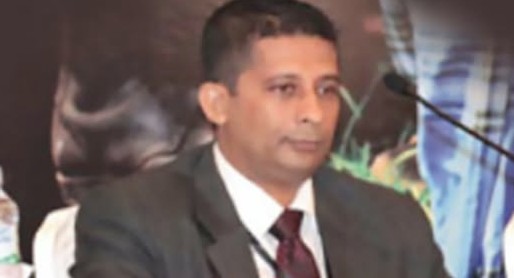
Basil Rajapaksa

Pranab Mukherjee
|