








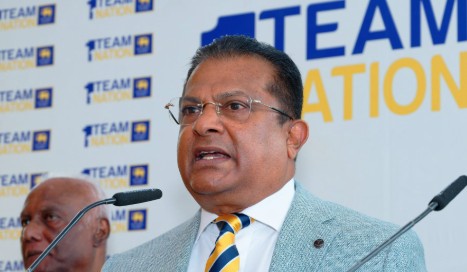


| APRC does not
represent all parties -Warnasingha Spokesperson for
the Jathika Hela Urumaya (JHU), Nishantha Sri Warnasingha
refutes the notion of ‘all party representative committee’ and
reiterates his party’s position that the unit of power
devolution should ideally be at the local government level.
Q: What is the view of the Jathika Hela Urumaya as a
constituent party of the United Peoples Freedom Alliance (UPFA)
on the All Party Representatives Committee (APRC)?
A: All though it’s called All Party Representatives
Committee or APRC it does not represent all parties. It does not
have main coalition parties of the government- the JHU, Mahajana
Eksath Peramuna (MEP), Thamil Makkal Viduthalai Puligal (TMVP)
or National Freedom Front (NFF) nor the main opposition the
United National Party (UNP) or the Janatha Vimukthi Peramuna
(JVP).
So the main stakeholders who contributed to the victory of
2005 and mandate given to President Mahinda Rajapaksa are not
represented in the APRC. Only four or five small parties are
represented. We don’t see any justification to call this ‘all
party’. So it’s unethical to continue to refer to this committee
as ‘all party.’
Q: So what does your party propose?
A: We see no validity in the APRC so what we ask is to
dissolve the APRC. There’s no validity in APRXC after
elimination of the Liberation Tigers of Tamil Eelam (LTTE) on
May 18. APRC was set up back in 2006 to bring about a political
settlement when the LTTE had significant military power. When
peace talks were held in Geneva the Government said that it
cannot take decision on its own and so APRC came into being.
The mandate of APRC was to seek consensus among all parties
and to report it to the Public where there was consensus among
all parties within the APRC. However this did not happen at all
times.
Prof. Tissa Vitarana believes that Tamils have political
grievances and the solution for this should be based on
Federalism. We see that as his personal opinion and respect
that. However none should promote his or her own personal
opinion in the guise of APRC.
At times the accepted practice of declaring views were not
adhered to and at times was over proportionate. Once he had
stated that JHU had agreed to some APRC ‘decisions’. Although
this was done with a view to accelerating the process, we see
this as undue pressure.
Q: Why do you say that there was ‘undue pressure’ on the
APRC?
A: We have evidence of some Western ambassadors and Non
Governmental Organisations (NGOs) of trying to pressurise the
APRC. For instance the Expert Committee draft of the APRC had
gone to the American, German and British diplomatic missions and
to an NGO before it was given to other parties.
Also this draft was an exact replication of President Chandrika
Bandaranaike Kumaratunga’s infamous package presented back in
2000. The mandate of the Expert Committee was to facilitate the
APRC by way of advising. They had no power to come out with a
draft on their own. That is usurping of power of the APRC and
was never their mandate.
Q: You said some actions of APRC as ‘unethical’. Can you
elaborate?
A: Once when the Eastern Provincial Council Election was
concluded there TMVP members who were elected into power. We
made a request that the TMVP be taken into the APRC and until
such time, APRC process be postponed. But the Chair did not
agree to allow them to be represented. When TMVP, a Tamil part
which had laid down arms and had entered mainstream democracy
was not taken in we asked that APRC be temporaraly suspended.
When the APRC came out with an Interim Report in January 23,
2007, President Mahinda Rajapksa was handed over until the final
report was decided upon. However JHU was also included in this.
It appealed President to make an effort to see the possibility
of how the 13th Amendment can be fully implemented and to
empower the Provinces with necessary executive, legislative and
judiciary powers. President had discretion to see what subjects
can be retained and what can be devolved.
But why give more powers to the North than what are given to
other provinces. No other province was given Police powers and
even Land powers to some extent. Why accord them with special
treatment? All what we appeal for is that all provinces be
‘served with the same spoon’.
Q: Why do you say that there’s no need for further
devolution of power?
A: Is giving Police powers to the Provinces the need of the
hour? There are thousands of IDPs are languishing in camps in
the North. So the need is to resettle them immediately and to
see their basic needs are met. That roads, bridges be built,
electricity and health facilities be given, ensure de-mining
takes place and to create a conducive environment to restart
their livelihoods.
There’s a National Revival taking place especially in the
war-ravaged North and East. What we now need is an ‘All Party
Council for Economic Growth and Posperity’. Talk of APRC will
create suspense and mistrust in the hearts and minds of the
public at a time of celebration like this.
Q: Does your party agree that Tamils have legitimate
grievances?
A: Tamil grievances were caused by none other than the
so-called ‘sole representative’ of Tamils- the LTTE. So this was
their political grievances. At this time their basic needs like
food, water and clothing should be met while restoring
democracy, and creating a new community-based leadership among
the Tamils is imperative and vital. Government must facilitate
this paradigm shift in the hearts of the Tamil people who
suffered much hardship due to Terrorism.
Q: India maintains that the Thirteenth Amendment be fully
implemented immediately. Do you see such a need?
A: 13th Amendment was a created by India and does not
represent the aspirations of our people. It was forcefully
placed upon our country, after India made the JR government to
kneel before it. Now they want to forcefully make us implement
it. Government should never give in to such bullying or
influence. India itself said Sri Lanka was a sovereign and
independent state. As such we ask India to keep out of our
internal matters which is unethical.
Q: So as the JHU sees, what options are available to the
government?
A: First step is to set up a Provincial Council in the North
as it is in the other provinces. Second is to see whether any
other powers should be given to Provincial council, but a
referendum should be kept to obtain the approval of the public.
Third is to go for Thirteenth Plus by having a two thirds
majority of Parliament and approval of people at a referendum.
Q: Other matters which are directly not linked to
devolution of power, are to be included in APRC proposals? Do
you see such need?
A: You see the issues of a Bicameral Legislature nor Vice
Presidency for minorities were never discussed in APRC. At least
there is no consensus on the unit of devolution. UPFA says it’s
the District. UNP along with 11 other parties say it is the
Province. We say it should be at the local government level.
Then there’s no agreement on the nature of state, whether
unitary or federal. Land be included no census.
Q: Don’t you think that 13th Amendment would be a stepping
stone to win the hearts of the Tamils and the international
community?
A: Firstly law and order should be restored and elections
have to be held to resolve grievances of Tamils and to win their
hearts. We don’t have to win the hearts of diaspora or other
countries if they still support Eelam or separatism. The test
would be to win the hearts of Tamils living here and alleviate
their suffering.
There is no need find solutions based on ethnicity. Even we have
problems with bureaucracy, bribery and corruption, law and
order. Then the answer would be to draft a new constitution and
not limit reforms to Tamils or any other community.
Q: If there were no grievances why did they support
Prabhakaran and his Eelam, in the first place?
A: There’s no evidence to show that all Tamils supported the
LTTE. That too they were forced to do as LTTE wielded military
power and as they were made hostages. Tamils did not willfully
flee Mannar to Killinochchi to Nanthikadal but they were forced
to. But there would have been some support. If that was so, why
did Tamils in Jaffna and Colombo did not hold even one protest
or picket? That happened in London to Sydney to New York to
Chennai but not here?
Q: If we don’t support devolution of power, don’t you
think that Tamils may take up arms again and there will be
another Prabhakaran?
A: We fought a ruthless terror outfit for over 30 years and
we saw the results. Anyone who saw the air power, the sea power
and suicide capabilities of the LTTE and how all that was
eliminated in Vellimullivaikkal, would not even dream of another
arms struggle. It was the Tamil themselves who had to pay the
heavy price. Nothing was ever be won by it. No sensible person
would ever dream of taking up arms again. That was seen not only
now but throughout history.
What we say is that the Tamils have the freedom to decide
their destiny. So all we ask is that we should live together as
one nation to lead this country from strength to strength. But
for any person who seeks to bring separatism to this country we
say the only answer was the one seen in Puthumathalan.
SF
**** |