

















|
The story of
‘Eelam War IV’

The Nation and RIVIRA Defence correspondent Tissa Ravindra
Perera has brought out a book titled ‘Wanni Maha Satana’,
presenting to Sinhala readers a ringside description of the
historic Wanni battle that ended the 23-year-old war with the
most ruthless and formidable terrorist outfit in the world.
Among the contents of this book is a graphic account of the
final hours of Tiger leader Velupillai Prabhakaran. The book
also contains hitherto unpublished details of the amazing feats
of our war heroes during ‘Eelam War IV’, from beginning to end,
the stuff that make a saga of human bravery and sacrifice. The
book also contains an array of rare pictures to lend support to
breathtaking accounts given in the book. Tissa’s previous works,
‘Deshaye Mura Devata Eli’, ‘Mavilaruwen Thoppigalata’ and ‘Wanni
Satana’ are popular among Sinhala readers. `Wanni Maha Satana’
is a PAHAN publication. |
Tigers in INGO clothing
By Tissa Ravindra Perera
Now that the Wanni battle is over, Intelligence sleuths are fully
engaged in tracking down and arresting Tiger hit-teams who had
infiltrated the city, to carry out attacks.
Military and Police Intelligence are not only successfully tracking
down the Tiger hit-teams, but are also in the process of uncovering
their sinister plans to create mayhem in the country.
Police Intelligence made a major breakthrough last week, when they
bared a Tiger plot to assassinate President Mahinda Rajapaksa, which had
been hatched with the connivance of two INGO officials and two local
politicians.
Explosives uncovered
This Tiger plan was uncovered following the arrest of a Black Tiger
who had been posing as a Muslim under the name Muskin. The day following
the arrest of Muskin, another LTTE cadre was nabbed with explosives in
his possession. Investigations later led to the arrest of a senior LTTE
cadre as well. Sleuths attached to the Western Province Intelligence had
discovered several bombs and large quantities of explosives from the
hideouts of the Tigers. In one instance, they discovered a gas cylinder
stuffed with over 40 kilograms of C-4 explosives at the residence of the
senior LTTE cadre arrested at Weppankulam, Vavuniya. 50 detonators, a
claymore mine, several bombs, hand grenades and wire rolls were among
other items recovered from this house. A magazine, some live bullets and
a micro-pistol were also recovered from the lodge of the Manager of Save
the Children.
Investigations have revealed that the explosives meant for assassinating
the President, had been transported to Colombo with the help of the two
politicians, who are to be arrested. shortly.
The enemy within
Meanwhile, three drivers, two from two UN Agencies (one located at
Kurumankadu, Vavuniya and the other at Puntottam), the third one from
‘Save the Children’, have now been arrested. It transpired during
investigations that the Tigers had planned to transport explosives to
Colombo from Kilinochchi by vehicles belonging to the UNHCR. Their mode
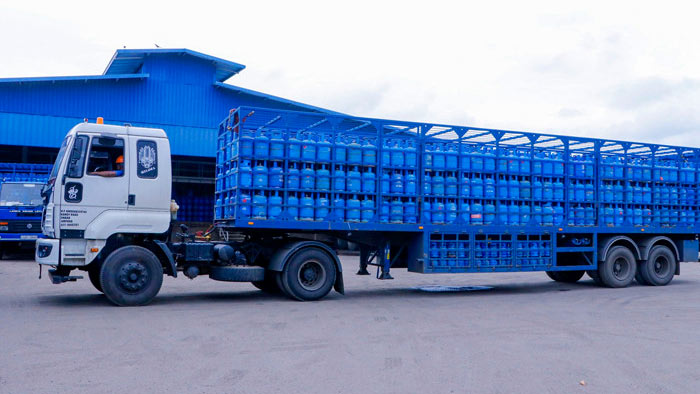
of operation was to pack domestic cylinders with C-4 high explosives
after removing the bottom cover and re-fixing it after packing. The
vehicles belonging to two INGO officials, one of them an American, the
other a Swede had been used to transport these cylinders packed with
explosives from Kilinochchi. The two INGO officials have been taken in
for questioning. Thanks to the efficient functioning of Western Province
Intelligence Division, several previous attempts to assassinate
President Rajapaksa and launch bomb attacks in the city by Tigers, could
be thwarted. The timely arrest of two Tiger suicide bombers, Vatsala and
Vadini, and a Police Inspector who had aided and
abetted
them, by the Western Province Intelligence Division, aborted another
attempt on the life of the President and his family members.
Meanwhile, State Intelligence is proceeding with investigations into
the case, where an Army Colonel bought by the LTTE, had planned to
assassinate the President, Defense Secretary Gotabhaya Rajapaksa and
Army Commander Sarath Fonseka.
It had transpired during these investigations that some officers from
the Army, Police and the Navy had maintained ties with the LTTE and
these officers are to be questioned.
War booty unearthed
Meanwhile, troops carrying out mopping up operations in
Wellamullaivaikkal, had unearthed currency notes amounting to Rs. 6.4
million and a large haul of gold jewelry worth millions of rupees,
buried inside a Tiger bunker. The authorities believe that the money and
gold jewelry were removed from safes and vaults of Tiger banks. The
currency notes and jewelry were found packed in polethene bags and
school bags and buried about a foot under the bunker. Money and jewelry
had been buried on the orders of Karikalan, and the Tiger leaders had
appropriated portions from this `treasure trove’, before retreating to
safety.
Prabhakaran’s parents have been brought to Colombo pending necessary
legal action to be taken against them.
Security authorities have learnt from a Tiger under interrogation, that
there had been three more `submarines’ similar to the one the troops
discovered near the ship Farah-3 at Wellamullaivaikkal quite recently.
The Tiger had revealed that they had put on a trial ride four submarines
they had turned out. It was following this information that troops
discovered the submarine near the ship. This submarine is believed to be
the target identified and hit by a surveillance plane of the Air Force,
which later came under the Army’s artillery fire as well, towards the
end of the Wanni battle.
Army Chief pays tribute
Army Commander General Fonseka, who paid a visit to Mulativu on June
19, which was, incidentally, the first ever visit paid to this war-torn
area by an Army Commander, took time off to inspect this Tiger
submarine. General Fonseka, who was at the scene of the last battle,
just one month after the historic victory, made it a point to pose for a
picture with the heroes of the last battle. Later, he addressed the war
heroes.
“There is no army in the world that has put a complete end to a war,
after destroying the entire enemy hierarchy. Our army has demonstrated
that its prowess and morale are not second to any other in the world.
Some thought that I was out of my mind, when I said that I would finish
the war in three years. We could successfully conclude this war that
raged for 23 years with no end in sight, in a matter of two years and 10
months, after destroying 22,000 Tigers. We prosecuted the war according
to a plan. We planned to corner the remaining Tigers in this stretch of
land, before destroying them, and we did it. We, at Puthukudiiruppu,
Putumatalan and Wellamullaivaikkal, repeated King Dutugemunu’s feats at
Vijitapura.
“The entire world has already accepted that the Sri Lanka Army has
achieved an amazing victory. We achieved this victory thanks to the
valour and bravery demonstrated by our soldiers in a spirit of
self-sacrifice. They fought day and night, undaunted by formidable odds.
I have come here today, to pay my tribute to our valiant soldiers, for
their memorable performance at this place just one month ago. All those
soldiers who contributed to the victory will be honoured with medals and
promotions,” said General Fonseka.
Promotions and postings
Steps are now being taken to award war medals to all heroes,
including the fallen ones. Lieutenants will be promoted to the rank of
Captain, Lieutenant Colonels to the rank of Colonel, and Colonels to the
rank of Brigadier.
Military Secretary Brigadier Sumith Padumadasa issued a letter on
June 22, appointing Colonel Aruna Jayasekara of the Gemunu Regiment, as
Director, Operations of the Army. His predecessor, Colonel Aruna
Wanniarachchi has been appointed Chief of Staff, Brigadier at the new
Division headquarters in Mulativu. Director Planning, Brigadier Mahesh
Senanayake has been appointed to act as Director Training, while
functioning in his substantive post.
Major General Jagath Dias, who commanded 57 Division that captured
Tiger bastions of Tampane, Periyatampane, Periyamadu, Palampiddi,
Tunukkai Mallawi and Kilinochchi up to Vishwamadu, has been appointed as
Deputy Ambassador to Sri Lanka’s embassy in Berlin. Major General Udaya
Perera, who functioned as Director Operations of the Army, had already
been appointed as Sri Lanka’s Deputy High Commissioner for Malaysia.
This was the first time that Army Officers have been appointed to
diplomatic positions while in active service. The main task entrusted to
these officers is to counter anti-Sri Lanka terrorist forces active or
likely to become active in the countries to which they have been posted.
****
Tissa Abeysekara: The enigmatic
genius
By Jayantha Anandappa (Sydney,
Australia)
It is with sadness that I pen these lines on Tissa Abeysekara who
had departed so suddenly and unexpectedly and in my opinion with his
mission not really accomplished. When I heard about his death, I felt
as if I have lost someone close and dear to me.
Although mainly acknowledged him as the best scriptwriter for cinema
Tissa’s contributions to art spread across many spheres. As a bilingual
writer he probably surpassed even the great Martin Wickremasinghe who
sounded somewhat “laboured” in English. Surely Tissa will be remembered
as an iconic figure in the contemporary cultural landscape just as
Lester James Peiris, Martin Wickremasinghe, Amaradeva or Sarathchandra.
Tissa had no vested interest in any specific camp, group or an
academy. To me that was one of his most endearing qualities as an
artiste/ critic. He was very much like an “outsider” to the art field
like his illustrious mentor, Lester.
His fearless independence and his vast knowledge in varied fields
were mirrored in his writings. His sharp, critical mind and the refusal
to accept any established view without critically assessing it and his
willingness to always back his views with reason was his hallmark. He
spoke and wrote both in Sinhala and English from his heart with
eloquence and flair-as if he had two mother tongues and I must confess
that I generally savoured whatever he wrote, particularly in English.
His peers would have envied his versatility. I would not blame them-
for Tissa was light years ahead of his peers including the university
dons when it came to language, oration and criticism in either language.
It is needless to say it is with his artistic creativity that he
reached the heartbeat of the people and it is for this that people would
like to remember him. His abundant creative talents and eloquence were
an adornment to his knowledge. Perhaps the reverse may be truer.
I think it is Tissa’s wandering mind that traversed across various
domains ranging from literature, music, history, cinema and art that
made that unique fascinating personality that he was.
What drew me to have a personal contact with Tissa was the “role” he
played as a musicologist or a music critic and his in-depth knowledge of
Sunil Santha’s works- a composer, vocalist and a man who had fascinated
me endlessly. I wanted to know more about this musician who was
unfairly victimised by the establishment. Hearing that Tissa was
planning to write a book on the great musician I continued to talk to
him and wrote to him urging him to start this task without postponing.
The book never eventuated- unfortunately.
It is this common interest on Sunil Santha initially and my
insatiable passion for literature and art films that made me continue
with my interactions with Tissa. It is through these conversations-
though short, random and sometimes far apart that I found the most
fascinating and intriguing facets of this truly great man.
It amazed me how Tissa kept on stubbornly refusing to acknowledge
his own masterpiece “Viragaya” as his best work and always referred to
“Mahagedara” as his best cinematic creation- a film with a theme that
drew heavily from melodramatic stock. When I disagreed he provided a
flimsy counter argument that “Mahagedara” was his own story but
“Viragaya” was not. I always thought there was a touch of hypocrisy in
this assessment. From his subsequent writings and from his lack of
interest to correct this position as evident from his silence on the
subject when the whole world had voiced a contrary view, it was clear
that Tissa was inclined to maintain his position for reasons unknown
until his death.
Even more intriguing was the position that he maintained through the
Sinhala newspaper columns from early nineties about the length of the
film (Viragaya) and that the full length movie was shown only in Regal
in the first two weeks of the first round of screening. In his writings
he had implied that whilst the film was running its producer had visited
the film theatres and had cut and chopped the film- her own production!
When I told him that I saw the film in Nugegoda which ran over 3 hours
and it looked in perfect order, he was quick to distract me by saying
that he shot the film originally for 4 hours. It was evident that the
theatre owners were the culprits who had skipped reels willy-nilly due
to the excessive length of the film. Tissa was aware of this, though he
chose to always blame the producer.
It is well documented that Tissa always lamented that he could not
complete one of his previous films “Mung Mula Wael” which the producer
Munidasa de Silva of Linton fame aborted after shooting was complete.
This was a much talked about topic in early eighties. Perhaps Tissa was
not an easy person to work with?
With “Viragaya” which is a miracle of art and a sublimely beautiful
“transcript” of Martin Wickremasinghe’s celebrated novel, quite
surprisingly Tissa could not find a producer. Though during the post-
Viragaya period he produced some noteworthy art work in the form of
teledrama (Pitagamkarayo- probably the best teledrama made in Sinhala,
“Vana Sarana” an absorbing drama based on Spittel’s famous novel) he was
drifting away from cinema, certainly as a filmmaker.
I am sure this deeply hurt his ego and troubled him because quite
rightly Tissa knew that he belonged to the cinema not teledrama- that
too as a director. He knew that he could have surpassed “Viragaya”.
After relinquishing his duties as the Chairman Film Corporation, in
response to one of my e-mails Tissa wrote on 13 Aug 2003 that “I have
scheduled the Sunil Shantha Book for next year. It requires hard work
and much time. At the moment I am trying to resurrect my career as a
filmmaker, after being in the bureaucratic wasteland for two-and-a-half
years trying to help others to make films”.
Tissa of course could never resurrect his career as a film
director. He once told me over the phone that he is on the verge of
finding a producer and is planning to embark on filming Sarathchandra’s
“Malagiya Aeththo”. Remembering that the novel was based in Japan I
quickly noted that “You may have to go to Japan to film it?” I remember
him saying “I like to do something big, something good”. Knowing what
he had achieved in Viragaya it raised expectations sky-high. I even
started to imagine how he would film some of those scenes from
Sarathchandra’s novel.
When I contacted Tissa again he was writing a script for Sunil
Ariyaratne (Uppalawanna) – the finished product was a dull work, lacking
intensity and human drama. Whilst Sunil Ariyaratne must take the lion
share of the blame for poor direction, Tissa’s script too was mediocre.
Identical comment applies to his script for the teledrama based on
Wickremasinghe’s much under-rated “Kaluwara Gedara”. But this does not
mean that Tissa’s talents were diminishing- perhaps to be permanently
labelled as a mere script writer- now in teledramas- a role that he was
always trying to get away from, way back from the “Karumakkarayo” days
would have been too monotonous and too stale to stimulate the creative
artist in him.
Realising that he could probably never make another feature film,
his wandering mind which was always oscillating between cinema,
literature, music, art, history and that apologetic unconvincing
leftist- he eventually turned to English fiction- one of his true
callings. He has already published “Bringing Tony Home” a highly
readable nostalgically evocative autobiographical “sketch” which won him
the prestigious “Gratiean Award” and established his reputation as a
serious writer of fiction in English in 1996.
His “In the Kingdom of my Sun and the Holy Peak” a collection of three
unrelated stories or novellas, amazingly engrossing and beautifully
written- is a type of a book only a literary genius could write. I
thought it is certainly a giant leap from his earlier work in English.
The three stories particularly the middle one must hold a very high
place in the contemporary English fictional writing in any country.
More was to follow, I thought gleefully.
I was pleased to hear that Tissa had recently re-published in
international press “Bringing Tony Home” and have added three more
stories to this. I was swamped with mixed feelings when I read that it
surpasses even his highly rated “In the Kingdom of my Sun—“
Tissa Abeysekara had made ground breaking far-reaching changes to
the cinema in the art of dialogues, story and script writing. But to
remember him merely as the best script writer would be to seriously
undermine his value as an artist. He was a genius who could not reach
the pinnacle of his career as a filmmaker as he could not find a
producer to work with since the immortal “Viragaya”. He returned to
fictional literature at twilight- probably his first love when he
realised that the doors of the cinema as a director would never open for
him again. But since then he has given us two outstanding literary gems
in English. Posterity will remember Tissa with gratitude for this. When
Tissa was about to embark on a long fruitful new journey and perhaps was
about to break into the international literary circle he was snatched
away “cruelly” from us. He was probably the best gift we had to the
world as a writer of English fiction and sadly was nipped in the bud.
This is where I think I should stop and salute this great man.
**** |