








 This
week saw the ‘birth’ of the United National Alliance
(UNA), a coalition of opposition political parties,
brought together by the necessity of challenging the
ruling United Peoples’ Freedom Alliance (UPFA) at
the upcoming presidential and parliamentary
elections.The UNA has been some time in the
making, mooted by its chief proponent Mangala
Samaraweera, leader of the Sri Lanka Freedom Party
(SLFP) ‘Mahajana’ faction who has soldiered on with
this concept of an alliance even in the face of
considerable opposition from stalwarts of the United
National Party (UNP) itself.
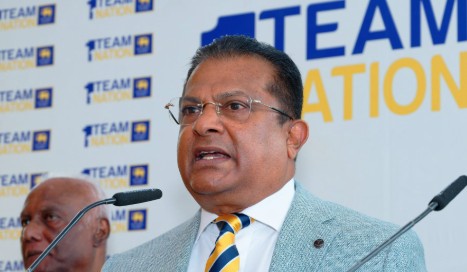
Samaraweera, at the launch of the UNA was to
proudly proclaim that this alliance was more
powerful than any that ever emerged in this country.
For the moment that must remain strictly rhetoric
but it is worthwhile to assess the relative
strengths of this new political force.
| UNP
fallen to abysmal depths |
It
is an undeniable fact that the only
political party within the UNA that can
stand on its own is the UNP. The next
most credible force is the Sri Lanka
Muslim Congress (SLMC) although there
too some doubts exist as to whether its
leader Rauf Hakeem has the blessings of
its entire membership to forge an
alliance with opposition political
forces.
Both the ‘Mahajana’ wing of the SLFP and
the Mano Ganesan led Democratic Peoples’
Front (DPLF) carry some clout but their
influence on a national level is
negligible. Such a scenario begs the
question as to why the UNP wanted to
hitch its wagon to an assorted array of
minute political forces when all it gets
in return is a few thousand more
votes-for which it may have to pay a
heavy price.
There is however a harsh truth the UNP
has to contend with. For a party which
once boasted of being the single largest
political entity in the country, its
popularity has fallen to abysmal depths.
Its grassroots level organisation is in
disarray and the party membership is by
and large a disgruntled lot. As recent
provincial council election results
showed, the party’s base vote has now
fallen to about 20 to 25 per cent |
It is an undeniable fact that the only political
party within the UNA that can stand on its own is
the UNP. The next most credible force is the Sri
Lanka Muslim Congress (SLMC) although there too some
doubts exist as to whether its leader Rauf Hakeem
has the blessings of its entire membership to forge
an alliance with opposition political forces.
Both the ‘Mahajana’ wing of the SLFP and the Mano
Ganesan led Democratic Peoples’ Front (DPLF) carry
some clout but their influence on a national level
is negligible. Such a scenario begs the question as
to why the UNP wanted to hitch its wagon to an
assorted array of minute political forces when all
it gets in return is a few thousand more votes-for
which it may have to pay a heavy price.
There is however a harsh truth the UNP has to
contend with. For a party which once boasted of
being the single largest political entity in the
country, its popularity has fallen to abysmal
depths. Its grassroots level organisation is in
disarray and the party membership is by and large a
disgruntled lot. As recent provincial council
election results showed, the party’s base vote has
now fallen to about 20 to 25 per cent.
Uncertain of its own standing in the electorate,
the UNP has now resorted to the ‘more the merrier’
policy, in the hope that having other political
parties stand alongside it in its battle against the
ruling party will help its cause. Hence the thinking
of the party leadership to forge an alliance.
However, conspicuous by its absence in the
Alliance is the other major political party in the
country, the Janatha Vimukthi Peramuna (JVP) which,
given its ideological differences with the UNP,
never relished the prospect of a political
partnership with the right-of-centre party. Thus,
while the UNA was busy announcing its arrival, the
JVP was busy mobilising trade union protests in the
city.
For a variety of reasons, the JVP still wishes to
go it alone, despite the prospect of yet another
embarrassing electoral performance which seems to be
inversely related to its organisational capability
and its ability to attract crowds. Therefore, the
contest at a general election will be very much a
battle between the UPFA and the UNA.
Judging by the political strengths of the UPFA and
the UNA as they stand now, the ruling party has a
clear advantage. It has many major leftist parties
such as the Lanka Samasamaja Party (LSSP), the
Communist Party (CP) and the Mahajana Eksath
Peramuna (MEP) under its wing and also enjoys the
support of other entities such as the Ceylon
Workers’ Congress (CWC) and the Thamil Makkal
Viduthalai Pulikal (TMVP).
Given the diversity of these political parties
and taking into account the considerable grassroots
growth of the SLFP itself in recent years, the UPFA
appears to be no match for the fledgling UNA.
However, there can be some confounding factors-such
as having the presidential elections first.
It can be safely said that the Sri Lankan voter
is extremely discriminating in the use of his
franchise. Therefore, the factors influencing his
decision making are vastly different in the two
elections. In a presidential poll, the personality
of the candidates counts a great deal while in a
general election, regional issues, caste and creed
considerations and party politics matter to a
greater extent.
Hence, it is in a general election that the UPFA
would have a clear cut advantage over the UNA. In a
presidential election on the other hand, it would be
more of a battle between the rival candidates rather
than the parties they represent. And, judging by the
recent public pronouncements of those who matter, it
is very likely that a presidential poll would
precede a general election.
There has been wild speculation in recent weeks
about the possibility of a ‘common candidate’ coming
forward to represent the UNA in the event of a
presidential election. There has been even more
feverish speculation as to who this ‘common
candidate’ would be, but for the moment this is at
best speculation and nothing more.
The political suspense has been further heightened
by announcements from the JVP that it would endorse
an ‘appropriate’ common candidate, if it could agree
with such a candidate on the possibility of
abolishing the executive presidency.
As political fever mounts more developments, some
of them bizarre, are unfolding. This week itself two
such events unfolded. Nandana Gunatilleke, for long
a leading light of the National Freedom Front (NFF)
and an able lieutenant of the more firebrand Wimal
Weerawansa resigned from all posts in the Front.
Thereafter, we heard of K.N. Choksy, Finance
Minister in the short-lived United National Front
government and the long-standing legal eagle of the
UNP publicly praising President Mahinda Rajapaksa.
That in itself is no cardinal sin, but it surely set
tongues wagging.
The stage is therefore dramatically being set for
next week’s announcement from President Rajapaksa.
The President is expected to outline his election
strategy to his party members next Sunday and that
will hopefully lay to rest all doubts about which
elections will be held first-but it will also be the
stepping stone for yet another round of feverish
electioneering. |