



























| First year in
office – a mixed bag
Next
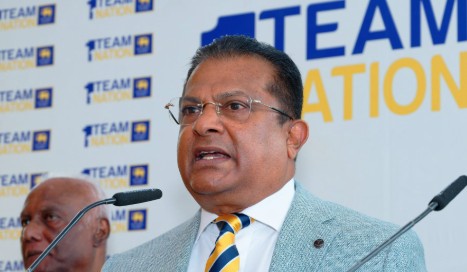
week Sri Lanka Cricket’s interim committee under the
chairmanship of DS de Silva will complete one year
in office. At least De Silva and his committee had
achieved what his predecessor Arjuna Ranatunga could
not, that is remaining in office for one year.
Ranatunga’s reign as chairman lasted for 11 months
before he was unceremoniously thrown out by Sports
Minister Gamini Lokuge with whom he had a running
battle during his tenure.
De Silva was appointed amidst several criticism
connecting his past to betting and whether he was
the right man for the job to carry Sri Lanka cricket
forward with his limited knowledge of man-management
skills. He was a Colombo Municipal playground
instructor and won fame through his cricketing
prowess. Through sheer dint of hard work he worked
himself up to become his country’s leading right-arm
leg-spinner, the likes of which has not been matched
even today. Geoff Boycott, Ravi Shastri and Ravi
Ratnayeke are similar examples. They were cricketers
with limited talent like De Silva but by hard work
and determination reached the top. Ratnayeke who
came into the national team as first change bowler
ended up opening the Test batting with Sidath
Wettimuny and scoring 93 in a Test in India.
It is unfortunate that De Silva played a major
part of his cricket during the pre-Test era and in
England where he appeared frequently in League
cricket as a professional. The cricket world was
witness to his talent only for 12 Tests and 41 ODIs
in a three-year period. When Sri Lanka was finally
granted Test status and played their inaugural Test
against England in 1982, De Silva who formed an
integral part of the team was 39 years old and
to-date remains Sri Lanka’s oldest player on Test
debut.
To De Silva’s credit it must be mentioned that
with the limited resources available to him at SLC
he has somehow managed to go to the Northern and
Eastern provinces and distribute cricket materials
to the schools. The performance of the Sri Lanka
under 19 cricketers in the recently concluded under
19 World Cup in New Zealand where they reached the
semi-finals is another feather in his cap. He did
what other past administrators had failed to do –
select a side representing the best talent from all
the provinces and putting them under the watchful
eyes of Aravinda de Silva, arguably the best batsman
produced by Sri Lanka in the post-Test era. Picking
Aravinda as consultant to the Sri Lanka under 19
team was a good move for there is no better
individual to pass on his skills and experience to
youngster than him. Further two of Aravinda’s former
team mates – Naveed Nawaz and Upul Chandana were
appointed as head coach and fielding coach
respectively. This combination proved a successful
support team for the under 19 World Cup. Further the
selection process involved players from all
provinces not those selected by the national
selection committee as in the past. The junior
selection committee headed by Sunil Wikramanayake
got plenty of feedback from the provinces before
they recommended a player to the pool. There was
more depth in selection and the range was wide.
Further, De Silva has managed to get work on
Sooriyawewa ground started, complete work on the
Pallakelle ground and also upgrade the once popular
De Soysa Stadium in Moratuwa which today is the
venue for the Inter-provincial Twenty20 semi-finals
and final. With Sri Lanka facing a paucity of Test
matches for 2010, the current IC has managed to
somehow get India to play a three-Test series at
home in July without which the country would have
played just two Tests against West Indies for the
entire year.
If one has to be critical of the De Silva
administration it is that the club infrastructure
and development has been ignored, no proper tours
scheduled for the Sri Lanka ‘A’ team, and the
failure to cut down on the over-sized staff at SLC
which today stands at 242 with a good majority of
them not having proper seats and working space. It
is no secret to state that SLC expends around Rs 170
lakhs per month on payment of salaries to these
employees and a further Rs. 150,000 per month on
fuel for six pool vehicles and Rs. 350,000-400,000
per month paying mobile phone bills. The De Silva
administration has failed to curb these rather
unnecessary expenditures at a time when SLC’s hands
are tied due to lack of finances. The failure to
utilise the experience of CEO Duleep Mendis, the
world’s most experienced cricket administrator and
Marketing Manager Charith Senanayake by curtailing
their day-to- day activities has been another
negative factor.
If De Silva wants to fulfill his ambition of
stirring up a new revolution by giving school
cricket, club coaching and national team priority,
he will need to tighten the loose ends first.
Otherwise he will also end up as some of his
predecessor’s of the past. |