
By Staff Reporter
Alcohol regulation in the United Arab Emirates sits at the intersection of legal reform, cultural values, and public safety. While the country has moved away from a blanket criminalization of alcohol consumption, the legal framework remains carefully controlled and uneven across emirates. For residents, tourists, and businesses alike, understanding where alcohol is permitted—and where it is not—continues to carry significant legal consequences.
A Changing Legal Landscape
The most significant shift in recent years came with Federal Law No. 31 of 2021, which restructured the UAE’s approach to alcohol-related offenses. The law removed the automatic criminal liability for consuming alcohol in authorized locations and transferred much of the regulatory authority to individual emirates.
As a result, alcohol is legal in the UAE, but not under a single national system. Each emirate now determines how alcohol may be purchased, possessed, and consumed within its jurisdiction. This decentralised approach has created a patchwork of rules ranging from liberal, tourism-oriented models to complete prohibition.
What has not changed is the state’s position on public order: unlicensed activity, public intoxication, and supply to minors remain criminal offenses enforced through the police and courts.
Why the Law Matters
Alcohol regulation affects far more than nightlife. It shapes the hospitality industry, event management, retail operations, and even private social gatherings. Hotels, restaurants, retailers, and event venues are subject to detailed commercial licensing requirements, while individuals remain responsible for ensuring that consumption occurs only in legally permitted settings.
Legal experts warn that misunderstandings—particularly by visitors or new residents—can lead to serious consequences. Violations may result in heavy fines, detention, business closures, or deportation for non-citizens. The framework reflects a deliberate balance: greater accessibility to support tourism and economic activity, combined with strict oversight to preserve public safety and cultural norms.
The Legal Foundation: Article 363
At the center of the current system is Article 363 of Federal Law No. 31 of 2021, which defines when alcohol-related conduct is lawful and when it becomes a criminal offense.
Authorized Places Only
Alcohol consumption is legal solely in locations authorized by the relevant emirate. These typically include licensed hotels, restaurants, bars, private residences, and approved retail outlets. Consumption outside these environments—such as in public spaces—remains illegal.
Unlicensed Activity
The law criminalizes the unlicensed possession, manufacture, transport, sale, or distribution of alcohol. This applies to individuals and businesses alike and includes hosting unlicensed drinking events. Penalties begin at fines of AED 500,000 and may include imprisonment.
Public Drinking and Intoxication
Drinking alcohol in public or appearing intoxicated in a manner that disturbs public order is a criminal offense. Punishments can include imprisonment of up to six months and fines starting at AED 100,000, reinforcing the clear boundary between private consumption and public conduct.
Protection of Minors
Supplying alcohol to anyone under the age of 21 is strictly prohibited. Businesses and individuals are required to verify age using official identification, with violations carrying potential imprisonment and substantial fines.
Confiscation and Enforcement Measures
Authorities are empowered to confiscate illegally obtained alcohol, close non-compliant venues, and seize profits or equipment linked to offenses. In certain cases, non-citizens may face deportation.
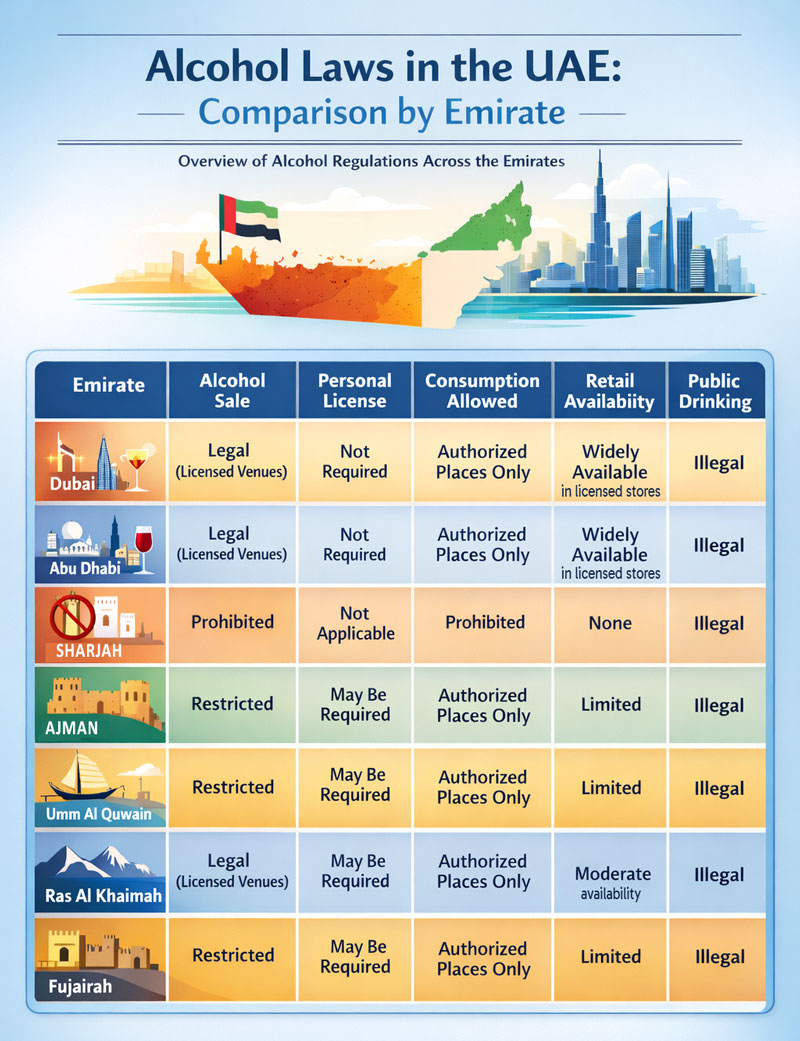
Differences Across Emirates
Alcohol policy in the UAE is not uniform:
Sharjah enforces total prohibition, banning the sale, possession, and consumption of alcohol.
Dubai and Abu Dhabi operate the most liberal systems. Personal purchase licenses are no longer required, though commercial licensing remains tightly regulated.
Northern emirates follow mixed models, allowing controlled retail access while maintaining strict venue licensing.
This flexibility allows each emirate to align alcohol regulation with its social priorities while remaining within the federal legal framework.
Penalties at a Glance
When alcohol use intersects with prohibited conduct, enforcement is swift:
Unlicensed possession, sale, or manufacture: Imprisonment and fines starting from AED 500,000
Public drinking or disruptive intoxication: Up to six months’ imprisonment and fines from AED 100,000
Supplying alcohol to minors: Imprisonment and fines up to AED 100,000
Operating unlicensed venues or events: Confiscation, closure, and possible deportation
These penalties underscore a consistent message: alcohol may be permitted, but only within clearly defined legal boundaries.
Legal Guidance and Compliance
Despite recent reforms, alcohol law in the UAE remains one of careful regulation rather than unrestricted access. For individuals and businesses, compliance requires a clear understanding of both federal law and emirate-level rules.
Legal practitioners note that early advice can prevent minor missteps from escalating into serious legal cases. From licensing and regulatory compliance to criminal defense, professional guidance plays a critical role in navigating this complex framework.
LYLAW, a Dubai-based law firm, advises clients on alcohol-related licensing, regulatory obligations, and legal defense. The firm represents individuals and businesses at all stages of alcohol-related matters, from investigations to court proceedings and clearance documentation, helping clients manage risk within the UAE’s tightly controlled legal environment.
Below is a Key FAQ section written in a neutral, news-agency style that can be added to the article without changing its tone or structure.
FAQs:
Is alcohol legal in the UAE?
Yes. Alcohol is legal in the UAE when consumed in locations authorized by the relevant emirate. However, legality depends on where and how alcohol is purchased, possessed, and consumed. Unlicensed activity and public drinking remain criminal offenses.
Do individuals need a personal alcohol license?
In Dubai and Abu Dhabi, personal alcohol licenses are no longer required for purchasing alcohol from licensed retailers. In other emirates, requirements may vary. Commercial licenses for selling or serving alcohol are still mandatory nationwide.
Where can alcohol be legally consumed?
Alcohol may only be consumed in authorized places such as licensed hotels, restaurants, bars, private residences, and approved venues. Drinking in public areas—such as streets, beaches, parks, or vehicles—is illegal.
Can alcohol be consumed at home?
Yes, consumption in private residences is generally permitted, provided the alcohol was obtained legally and consumption does not cause disturbance or violate other laws. Hosting unlicensed commercial-style events involving alcohol can still trigger legal action.
Is public intoxication illegal?
Yes. Being intoxicated in public, particularly if it causes disturbance, nuisance, or safety risks, is a criminal offense. Penalties can include fines, imprisonment, and deportation for non-citizens.
What is the legal drinking age in the UAE?
The legal age for purchasing and consuming alcohol is 21 years. Supplying alcohol to anyone under this age is illegal and carries severe penalties.
Can tourists buy and drink alcohol?
Yes. Tourists may purchase and consume alcohol in licensed venues and approved retail outlets, subject to the laws of the emirate they are visiting. Tourists are equally subject to public conduct and intoxication laws.
Is alcohol completely banned in any emirate?
Yes. Sharjah maintains total prohibition on alcohol, including sale, possession, and consumption. Other emirates apply varying degrees of regulation.
Can alcohol be transported between emirates?
Transporting alcohol without proper authorization or into a prohibitive emirate can result in criminal charges. Transport should be limited to legal purchases and compliant jurisdictions.
What happens if someone violates alcohol laws?
Depending on the offense, penalties may include large fines, imprisonment, confiscation of alcohol, closure of businesses, and deportation for non-citizens. Enforcement is handled through police and the courts.
Do businesses face stricter rules than individuals?
Yes. Businesses involved in selling, serving, storing, or distributing alcohol must meet strict licensing and compliance standards. Violations can lead to license revocation, closure, and criminal prosecution.
Have alcohol laws become more relaxed overall?
Access has expanded in certain emirates to support tourism and economic activity. However, enforcement remains strict where public order, licensing, or safety is concerned. The system emphasizes controlled access rather than unrestricted freedom.












 English (United States) ·