
 Novella Carpenter, one of five women who launched BioFuel Oasis two decades ago, in front of the rebranded shop, with its newly painted sign. Credit: Nathan Dalton
In the mid-2000s — when the Iraq War was raging, when documentaries like Who Killed the Electric Car? and An Inconvenient Truth were being filmed, when bicyclists boasted they were making a “quiet statement against oil wars” — five women opened a small shop in West Berkeley selling biodiesel, a fuel made from recycled vegetable oil.
The women later moved the shop, which they called BioFuel Oasis, into a former gas station in South Berkeley, at the busy corner of Ashby Avenue and Sacramento Street. And after a year’s worth of renovations and landscaping, they turned it into a place that catered not only to a small but fervent contingent of diesel car owners looking to resist the petroleum economy, but also beekeepers, chicken keepers and urban farmers.
A book called Not a Gas Station, written by co-founder Jennifer Radke, outlined the history of the collective, and gave tips to readers on how to create their own biodiesel fueling stations.
 The shop is located in a former gas station at the intersection of Ashby Avenue and Sacramento Street in West Berkeley. Credit: Nathan Dalton
But, as the electric car industry has come back to life and new state laws have tightly regulated the sale of biodiesel, the demand for the alternative fuel has plummeted.
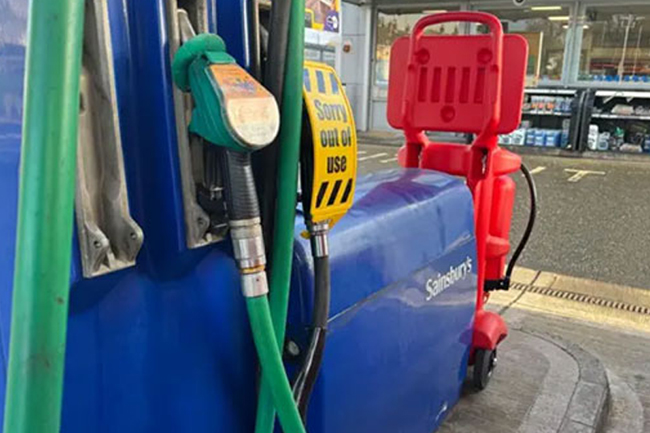
Now the newly rebranded Urban Farm Oasis has shut off its fuel pumps for good, turning its focus to urban farming, already a key part of the shop’s retail offerings.
These days especially, the business is decidedly not a gas station.
Owners took veggie oil from restaurants and made it into biofuel by hand
 Instead of selling junk food and cigarettes like other fuel station, the shop sells urban farming supplies like beekeeping gear and hay bales, plus honey, kombucha and beeswax candles from local makers. Credit: Ximena Natera, Berkeleyside/CatchLight Local
BioFuel Oasis began in 2003 as a worker-owned collective run out of a garage on Fourth Street in West Berkeley, in what co-founder Novella Carpenter called a “roll door operation.”
All of the founders had been making biodiesel themselves, scrounging veggie oil from local restaurants and processing it at home. It was an arduous and time-consuming affair. So the women banded together to more efficiently source locally made B99, a fuel blend made from 99.9% renewable sources. As popularity picked up, the founders realized they needed a bigger space.
The former gas station at Ashby and Sacramento had been built in the 1930s by a school teacher named Sue Irwin, and was most recently a car wash, called Kandy’s Detail, run by a man named Kandy Alfred.
The women bought the shop from Alfred and started construction in 2008. The old pumps had to be removed, as did the ground tanks. The owners, along with a team of volunteers, tore down the old brick canopies and replaced them with canopies made of lumber from former street trees and topped them with solar panels. They also planted wildflowers and other California native plants in raised beds to keep them safe from the old gas station’s potentially toxic soil.
The refurbishing took about a year with funding coming from community donations and a $100,000 loan from the City of Berkeley.
Co-founder’s book helped set off the urban farming boom
 The shop has sold chicks to people interested in raising chickens for small-scale egg production. Credit: Ximena Natera, Berkeleyside/CatchLight Local
Instead of selling soda, cigarettes and junk food like most fuel stations, the shop sold urban farming supplies — beekeeping gear, hay bales, veggie starts, chicken feed, and even baby chicks. It also carried local honey, eggs, kombucha, beeswax candles and more from Bay Area makers. Soon, customers who had no interest in biodiesel began flocking to the store to buy these items.
Many of those customers also went to meet Carpenter herself, who became a celebrity of sorts after her book Farm City: The Education of an Urban Farmer, was released in 2009. The book, which helped kick off the urban farming boom, describes how Carpenter took an abandoned plot in Oakland’s Ghost Town neighborhood and transformed it into a thriving farm, complete with goats, chickens, turkeys, rabbits and even a pair of pigs.
 Kate Hobbs, a co-owner of the shop, in 2023. Credit: Ximena Natera, Berkeleyside/CatchLight Local
Carpenter, who left the shop in 2011 before returning in 2020, studied with Michael Pollan at UC Berkeley’s Graduate School of Journalism, and is also a professor at the University of San Francisco, where she teaches urban agriculture.
Carpenter is the sole remaining owner of the original five. The others left over the years to pursue other careers. Carpenter currently owns the shop with Kate Hobbs, a former martial arts instructor, who came on board in 2020.
Tightened biodiesel regulation prompts a pivot
Things began to change for BioFuel Oasis in 2015 when the California Air Resources Board (CARB) adopted the Alternative Diesel Fuels regulation, which limited the sale of B99. Although burning the fuel emits fewer greenhouse gases than gasoline or traditional diesel, there were concerns about nitrogen oxides and particulate matter emissions from certain biodiesel blends.
The best the shop could do was sell B20/R80, a blend of 20% biodiesel and 80% “renewable diesel,” a fuel made from vegetable oil and animal fats like biodiesel, which is more energy intensive to manufacture.
“So then we had a little bit of a wane,” said Carpenter. “People were like, ‘Oh, I’m not that interested in supporting that fuel, which may have a larger carbon footprint.’”
The new regulation, plus the rise of electric cars — zero-emission vehicle sales rose by over 1,000% in the last decade — meant that BioFuel Oasis was unable to offer the same kind of resistance to the petroleum economy on which they built their brand. Eco-conscious drivers now have more options beyond biodiesel, which has shrunk the shop’s consumer base.
So the shop started to focus more and more on urban farming supplies, and began carrying more locally made goods. They did manage to keep some B99 on hand, sold not at the pump, but in 5 gallon carboys, and not taxed or marketed as fuel (one potential use is a a solvent for ocean cleanup, according to Carpenter). They also upped their workshop offerings. The shop has taught classes on chicken raising, sewing and mending, fruit tree grafting, kombucha and sauerkraut making, composting and other basic homesteading skills.
In late 2023 the shop opened the Oasis Coffee Caravan, a retro camper turned coffee cart, serving coffee, chai and toast. And on Fridays, free soup!
On a recent rainy Friday, Hobbs made winter vegetable chowder with rutabagas, turnips, onions, and herb-rich milk, and studded with homemade sourdough croutons.
 Hobbs serves up winter vegetable chowder on Fridays. Credit: Nathan Dalton
“The soup thing is just a free soup that we offer to the community,” said Carpenter. “We have a lot of people that are struggling financially in South Berkeley, so we like to make soup and then our customers eat it, too. We’re not like trying to feed the poor. We’re just trying to have soup, and create community.”
The next big project for Urban Farm Oasis is getting rid of the 7,000-gallon tank that stored the shop’s biodiesel. Carpenter mused about what to do with the space once the tank was gone.
“It might be a classroom space,” she said. “ Maybe we’re going to grow plants there. Maybe it’s going to be a tiny house for employee housing. So lots of things could happen.”
But whatever the future holds, Carpenter is glad that a new chapter has begun for the shop.
“I’m ready to be the Urban Farm Oasis,” she said. “We did biodiesel. It was awesome. A great 20 years. But those diesel cars are dying now, right? It’s time to let that all slough away.”
Urban Farm Oasis, 1441 Ashby Ave., Berkeley. Phone: 510-665-5509. Hours: daily, 10 a.m.- 6 p.m. Connect via Instagram.
 Wildflowers and other California native plants grow in raised beds to keep them safe from the old gas station’s potentially toxic soil. Credit: Ximena Natera, Berkeleyside/CatchLight Local
Related stories

"*" indicates required fields
Send a private note to the editors.*
See an error that needs correcting? Have a tip, question or suggestion? Drop us a line.
This field is hidden when viewing the form
Embed URL











 English (United States) ·