
January 3, 2026 — Bitcoin’s journey into the new year has begun on a cautious note, with the flagship cryptocurrency grappling with price resistance below key psychological levels and broader market forces exerting downward pressure. After a dramatic 2025 marked by record nominal highs and significant volatility, analysts and investors are now weighing whether Bitcoin’s near-term trajectory will rekindle bullish sentiment or extend its recent consolidation phase.
Price Action: Near $88,000 Amid Volatility
Bitcoin (BTC) opened 2026 trading around the mid-$80,000s, with price action remaining subdued and failing to convincingly break above the $90,000 threshold that many traders had highlighted as a pivotal resistance level. Thin liquidity over the holiday period and ongoing market caution have contributed to sideways movement, keeping Bitcoin’s price near $88,000 as traders enter the first full week of the year.
The performance contrasts with 2025’s earlier highs, including peaks exceeding $126,000, and positions Bitcoin for its first annual loss since 2022, with the year closing down approximately 5–6 percent.
Institutional Flows and Market Sentiment
Despite muted price action, institutional interest remains a key market theme. Spot Bitcoin ETF flows reported by major asset managers, including an $88 million daily inflow into Fidelity’s Bitcoin ETF, signal continuing institutional appetite for regulated BTC exposure. Such flows are often interpreted by traders as a bellwether for confidence among traditional investors.
Corporate accumulation has also resumed in recent trading sessions. Strategy, the largest corporate holder of Bitcoin, reinitiated purchases after a short pause, adding over 1,100 BTC and bringing its total holdings above 672,000 BTC.
Derivatives, Options Expiries, and Market Dynamics
Market participants face additional technical considerations. A meaningful slate of Bitcoin options—worth more than $1.8 billion in notional value—is expiring in the first days of January, a periodic event that can intensify volatility or cement positioning ahead of early 2026.
With macroeconomic correlations increasing, Bitcoin has been observed to move in tandem with broader risk assets, particularly U.S. equities, challenging the narrative of pure digital-asset isolation and reinforcing its emerging status as a risk-on instrument.
Regulatory and Infrastructure Developments
Regulatory environments continue to evolve globally. Policymakers in the United States and other major jurisdictions have advanced frameworks aimed at clarifying digital asset markets, stablecoin oversight, and market structure. While regulatory clarity is welcomed by many institutional investors, it also raises compliance expectations for market participants.
In the private sector, innovation in Bitcoin infrastructure persists, with companies securing fresh funding to expand Lightning Network-powered payment solutions designed to increase transaction speed and efficiency — an important milestone in scaling Bitcoin beyond store-of-value narratives.
Security and Fraud Concerns
The FBI has reported a significant rise in Bitcoin ATM-related fraud, with U.S. citizens potentially losing in excess of $330 million in 2025. Authorities warn that older demographics are particularly victimized, prompting calls for stronger consumer protections and industry accountability.
Looking Ahead
As Bitcoin enters 2026, market observers remain divided. Optimists point to institutional inflows, expanded regulatory frameworks, and sustained corporate accumulation as foundations for renewed growth. Skeptics highlight the lack of sustained breakout above major technical levels and persistent volatility shaped by macroeconomic trends.
Whether Bitcoin’s early-year performance will transition into a durable bullish cycle or extend its consolidation phase will likely depend on macro drivers, regulatory clarity, and institutional commitment—factors that will remain under close watch as markets adjust to post-halving realities and evolving investor behavior.
Below is a newspaper-style Bitcoin update that integrates charts and data points to provide a clear, data-oriented snapshot of the market as of early January 2026.
Bitcoin Market Update: Sideways Price Action, Macro Pressures, and Institutional Signals
Bitcoin (BTC), the world’s largest cryptocurrency by market capitalization, opened the new year in a consolidation phase, with price and volume data showing limited directional conviction from traders. Institutional flows, regulatory developments, and broader macroeconomic dynamics continue to shape market expectations for 2026.
1. Bitcoin Price Chart (Late 2025 – Early 2026)
Daily BTC Price (BTC/USD)
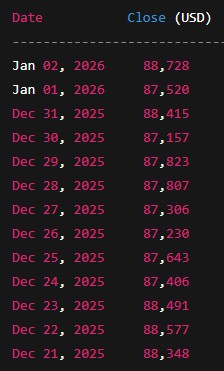
Rolling snapshot of key daily closes (Dec 19, 2025 – Jan 2, 2026):
Six-Month Range Highlights
6-Month High: ~$126,229 (October 2025)
6-Month Low: ~$80,591
Current Range: ~$87,000 – $90,000 sideways price action
Interpretation: BTC has traded in a tight range around $87,000–$88,000 in recent sessions, reflecting a consolidation pattern after sweeping volatility in late 2025.
2. Price & Volume Dynamics
Key Daily Statistics (Recent Market Data):
Live BTC market price: ~$90,000 (varies by exchange)
24-hour trading volume (global): ~$43 billion–$61 billion
Circulating supply: ~19.97 million BTC
Short-Term Trend Observations:
• Bitcoin’s 24-hour price range remains compressed, indicating low volatility and range-bound sentiment.
• Trading volumes have not delivered a breakout signal, keeping technical momentum subdued.
3. Institutional Flows & ETF Data
Bitcoin Spot ETF Net Flows:
Total historical BTC spot ETF net inflow (aggregate supply): ~632,660 BTC (cumulative)
Short-term ETF activity includes modest outflows, suggesting rotation or profit-taking among institutional participants.
Context: Institutional vehicles can serve as a barometer of professional investor appetite, and mixed ETF flows highlight uncertain institutional positioning in the near term.
4. Technical and Sentiment Indicators
Support & Resistance Observations:
BTC has found technical support around the $87,000–$88,000 zone over the past two weeks.
Resistance remains near the $90,000 threshold — a level that, if flipped, could prompt renewed upside attempts.
Trend Commentary:
Market analytics outlets note Bitcoin sitting in a rising wedge pattern in recent price action — a formation that often warns of trend continuation rather than reversal unless key support breaks.
5. Market Narrative and Observations
Price Performance 2025:
• Bitcoin achieved new all-time highs above $126,000 mid-year but ended 2025 with a modest downtrend of ~5% from the start of the year.
Investor Sentiment:
Industry observers describe the overall sentiment as cautious and range-oriented, with reduced volatility compared with earlier 2025 spikes.
Infographic Snapshot (Data Summary)
MetricValue (Approx.)
| Current BTC Price Range (Late Dec-Jan) | $87,000 – $90,000 |
| 6-Month High | ~$126,229 |
| 6-Month Low | ~$80,591 |
| Market Cap | ~$1.7–$1.8 trillion |
| 24-Hour Volume | ~$43–$61 billion |
| ETF Net Inflows (Cumulative) | ~632,660 BTC |
Outlook Into 2026
Analysts caution that breakout or breakdown from the current consolidation range will be critical in the coming weeks. A sustained move above $90,000, backed by volume and institutional commitment, might signal renewed bullish momentum, while a breach below $85,000 could invite deeper retracement.
Investors continue to monitor macro forces, ETF flows, on-chain liquidity, and regulatory developments as BTC navigates this transitional market phase.

















 English (United States) ·