
AVENGERS: DOOMSDAY THEORY — PART I
Doctor Doom Is Not Ending the World. He Is Replacing It.
By Senior Entertainment Correspondent
Marvel Studios has always hidden its biggest ideas in plain sight. With Avengers: Doomsday, the clues suggest something unprecedented: the film is not about planetary destruction, multiversal collapse, or even the defeat of Earth’s Mightiest Heroes.
It is about succession.
According to emerging narrative theory, Doctor Doom’s true objective is not the Avengers themselves—but their children. Not to kill them outright, but to remove them from history as it exists and reinsert them into a future designed by Doom alone.
This is not conquest.
This is authorship.
The Shift in Marvel’s Storytelling
For over a decade, Marvel has told stories of heroes confronting threats external to themselves: invasions, tyrants, extinction events. Doomsday appears to mark a pivot inward—toward lineage, inheritance, and the fragility of legacy.
The MCU has quietly introduced a next generation:
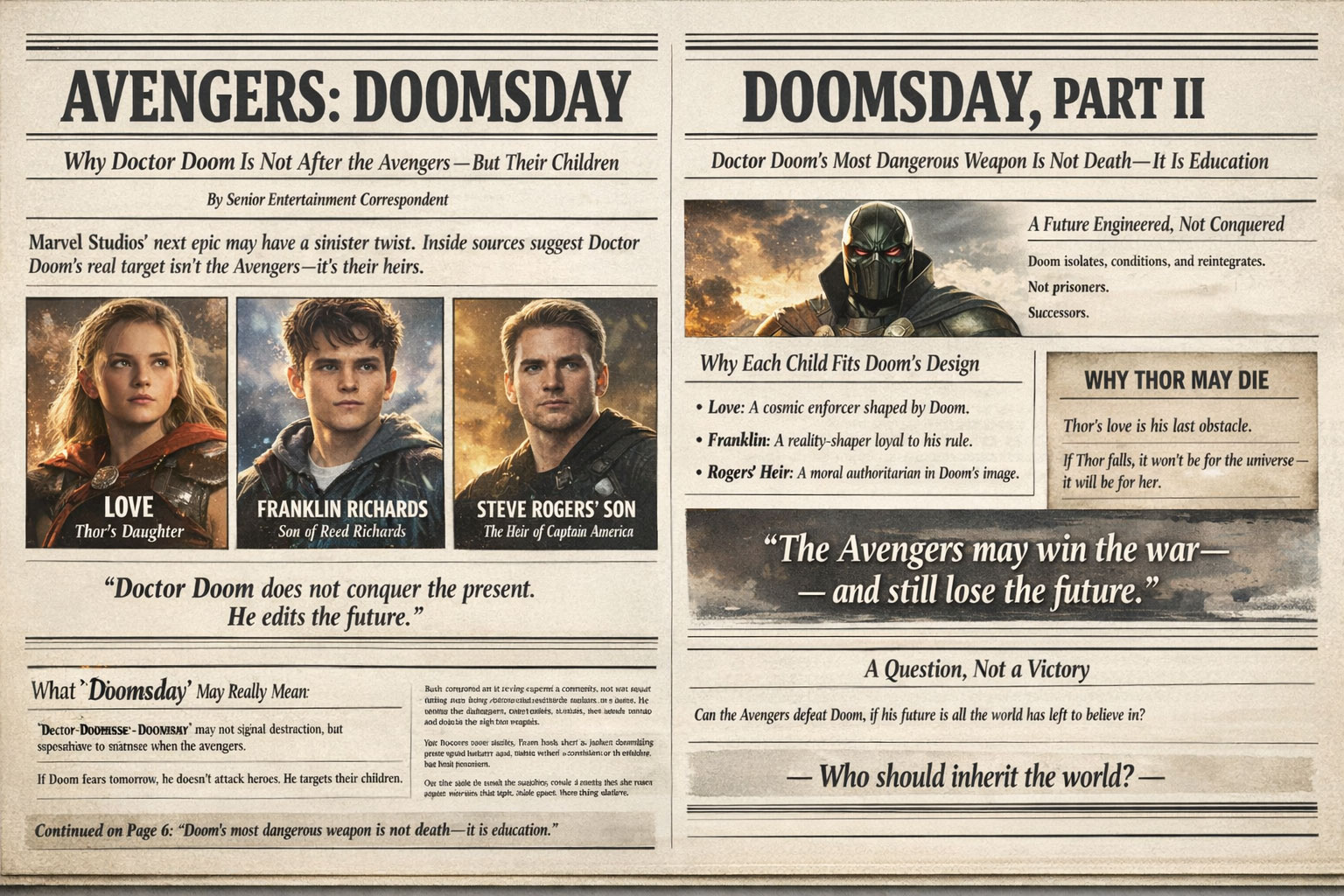
Love, daughter of Thor
Franklin Richards, son of Reed Richards and Sue Storm
A hinted heir to Steve Rogers’ moral legacy
Individually, these characters look like emotional epilogues. Together, they form a pattern.
Doctor Doom sees that pattern too.
Why Doom Targets Children, Not Heroes
Doom has always understood what most villains miss: heroes are temporary; ideas are not. Killing an Avenger creates a martyr. Allowing their ideals to evolve unchecked creates a rival civilization.
Children, however, exist before ideology hardens.
In this theory, Doom’s logic is ruthless but coherent:
If the future defeats him, then the future must be rewritten first.
The Three Pillars of the Future
Love: Power Without Precedent
Love is not merely Thor’s daughter. She is a being resurrected and empowered by Eternity itself—a cosmic force older than gods. Unlike Thor, Love does not carry centuries of tradition or restraint.
She is raw potential.
To Doom, Love represents the enforcement arm of the future: a god who could bring peace not through debate, but inevitability.
Franklin Richards: Reality’s Architect
Franklin Richards is the single most dangerous being in Marvel canon—not because of aggression, but because of subconscious creation. He does not conquer realities; he imagines them.
Doom’s rivalry with Reed Richards has always been intellectual. With Franklin, it becomes existential.
If Franklin grows up believing Doom’s rule is necessary, then entire universes may emerge where Doom’s order is simply “how things are.”
No rebellion.
No resistance.
Just design.
Steve Rogers’ Son: The Moral Weapon
Power alone does not sustain empires—legitimacy does. A Rogers heir raised under Doom’s ideology would embody something terrifying: ethical authoritarianism.
Not a tyrant.
A believer.
Someone who argues that freedom must be limited to save humanity from itself—using Captain America’s own moral language to justify control.
For Doom, this is the keystone.
What “Doomsday” Really Means
If this theory holds, Doomsday is not the end of the world. It is the end of uncontested legacy. A day when the Avengers realize that saving humanity once does not guarantee it remains free forever.
The threat is no longer extinction.
It is replacement.
And in Part II, the theory turns darker.
Because Doctor Doom may already be winning.
AVENGERS: DOOMSDAY THEORY — PART II
The Avengers’ Greatest Fear Is Not Death — It Is Survival
By Senior Entertainment Correspondent
If Part I of the Doomsday theory asks what Doctor Doom is doing, Part II confronts the more devastating question:
What if the Avengers stop him too late?
Doom’s Most Cruel Victory
Doctor Doom has never needed universal destruction to assert dominance. His most successful timelines—according to Marvel lore—are those where he rules because people accept his logic.
This theory suggests Doom’s plan unfolds in three phases:
Isolation — Removing the children from their parents, not violently, but strategically
Education — Teaching them a worldview where chaos is humanity’s greatest enemy
Reintroduction — Returning them to the world as its “natural” leaders
By the time the Avengers intervene, the children may no longer see themselves as victims.
They may see themselves as solutions.
The Avengers’ Impossible Choice
Imagine the emotional core of Avengers: Doomsday not as a final battle—but a reunion.
The Avengers find the children alive. Safe. Educated. Powerful.
And loyal—to Doom.
Do they fight them?
Do they imprison their own children?
Do they destroy a future that claims to have ended war, hunger, and chaos?
This is where the Avengers’ traditional morality breaks.
Why Thor May Die
If Love is central to Doom’s future, Thor becomes the greatest obstacle. Not because of power—but because of influence.
Thor represents something Doom cannot replicate: unconditional love without control.
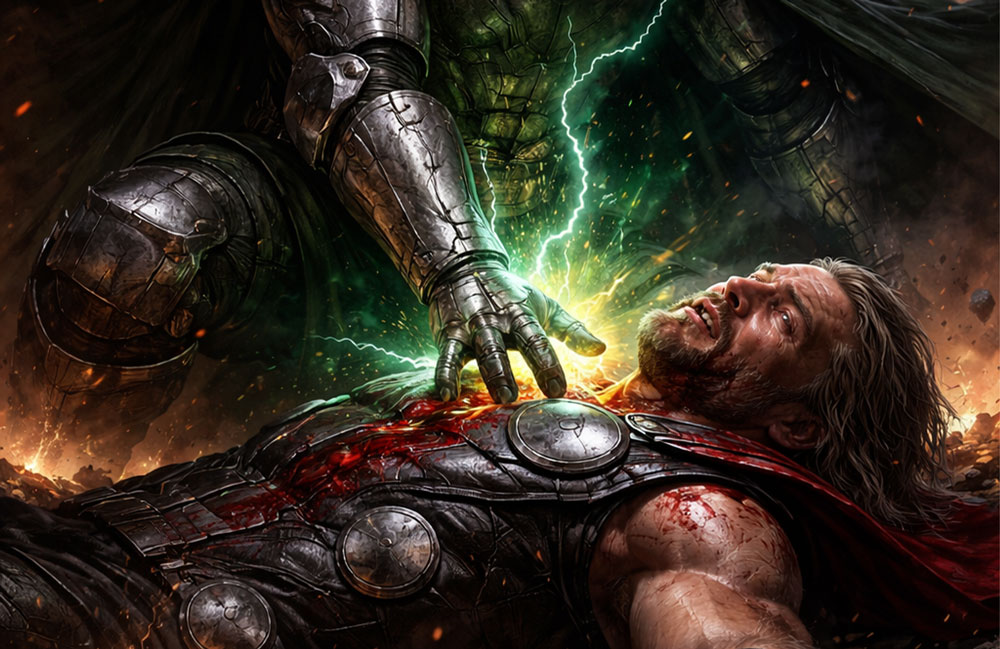
A growing theory suggests Thor’s death is not incidental—it is necessary. Love cannot be reshaped while Thor lives.
If Thor falls, it will not be in battle for the universe—but in defense of a child who no longer needs saving.
The End of the Old Avengers
By the film’s conclusion, the Avengers may technically “win.” Doom may fall. His immediate plan may collapse.
But the damage will remain.
The next generation will not return unchanged.
The world will have seen an alternative—and some will prefer it.
The Avengers will realize that their era was built on reaction, while Doom’s was built on design.
The Final Question of Doomsday
Avengers: Doomsday may end not with triumph, but with uncertainty.
Not:
“Who will win?”
But:
“Who should lead?”
Doctor Doom’s most terrifying possibility is not that he conquers the future.
It is that the future chooses him.
And that, more than any explosion or death, may be Marvel’s darkest ending yet.









 English (United States) ·